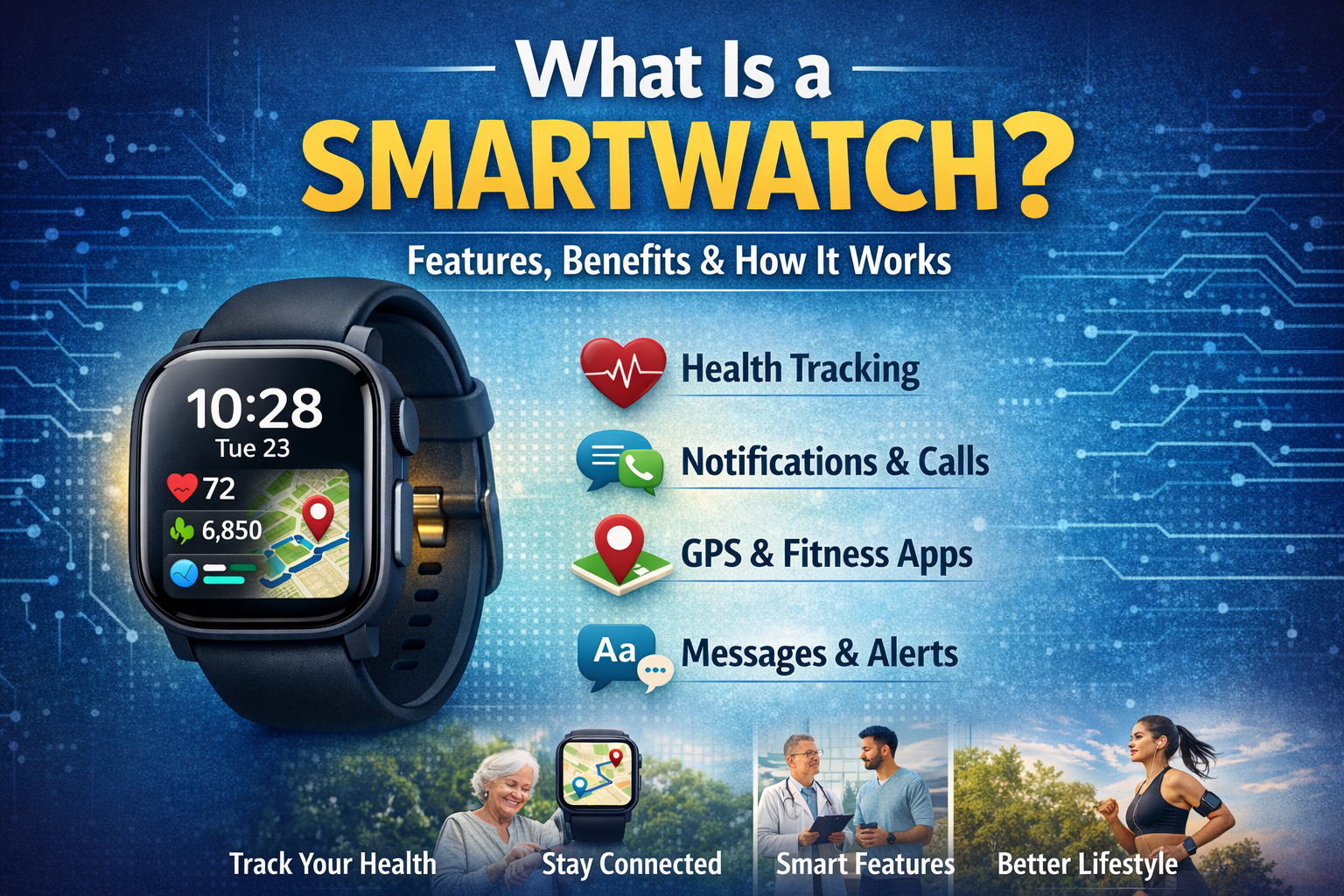
You are standing in a store (or hovering over a “Buy Now” button), looking at a watch strap that seems perfect, but you are stuck wondering: what size are typical smartwatch wristbands? It’s Rugged Orange. It’s Titanium. It’s exactly what you want. But then you see the numbers: 20mm? 22mm? 41mm? 45mm? QuickFit? QuickRelease?
Why Is Finding the Right Strap So Hard?
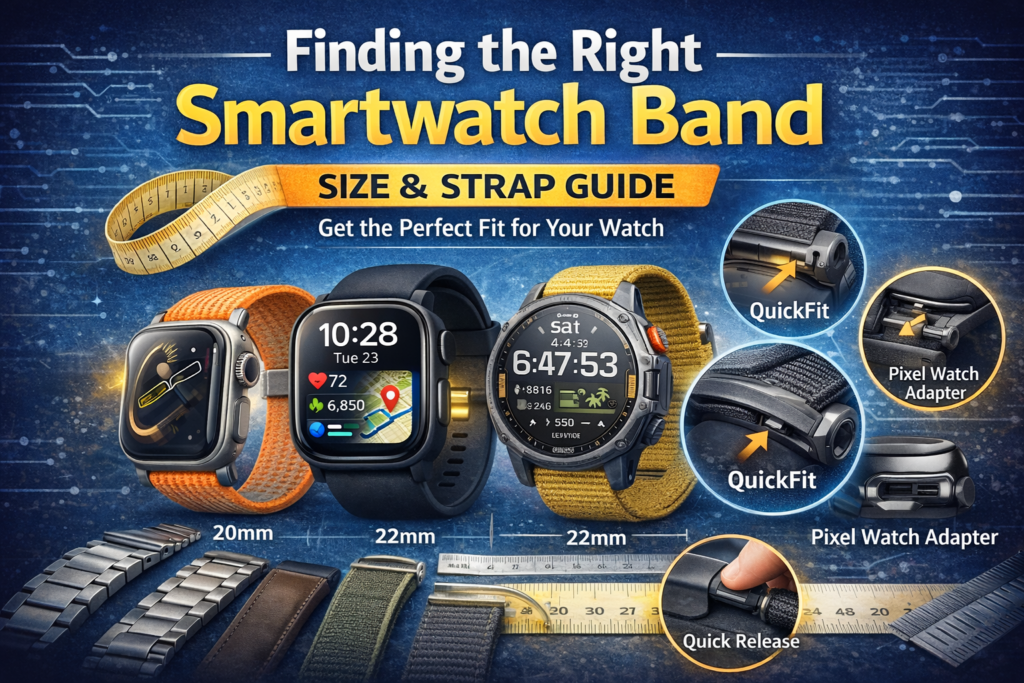
In 2026, the smartwatch industry has fragmented into a confusing maze of proprietary connections and varying millimeter standards. A difference of just 1 millimeter can be the difference between a comfortable fit and a $400 smartwatch crashing onto the concrete because the pin popped out.
As a tech consultant who has managed devices for hundreds of clients-from construction crews needing rugged Garmin setups to executives sporting Apple Watch Ultras-I have seen every sizing mistake possible. I have seen universal bands that didn’t fit and expensive leather straps ruined because they were the wrong lug width.
This guide is your solution. We aren’t just scratching the surface; we are diving deep into the mechanics of every major brand in the US market. Whether you own a Samsung, Apple, Garmin, Google or Amazfit device, this article will tell you exactly what you need to know.
What Size Are Typical Smartwatch Wristbands?The Fundamentals of Watch Anatomy
What is Lug Width and Why Does It Rule Everything?
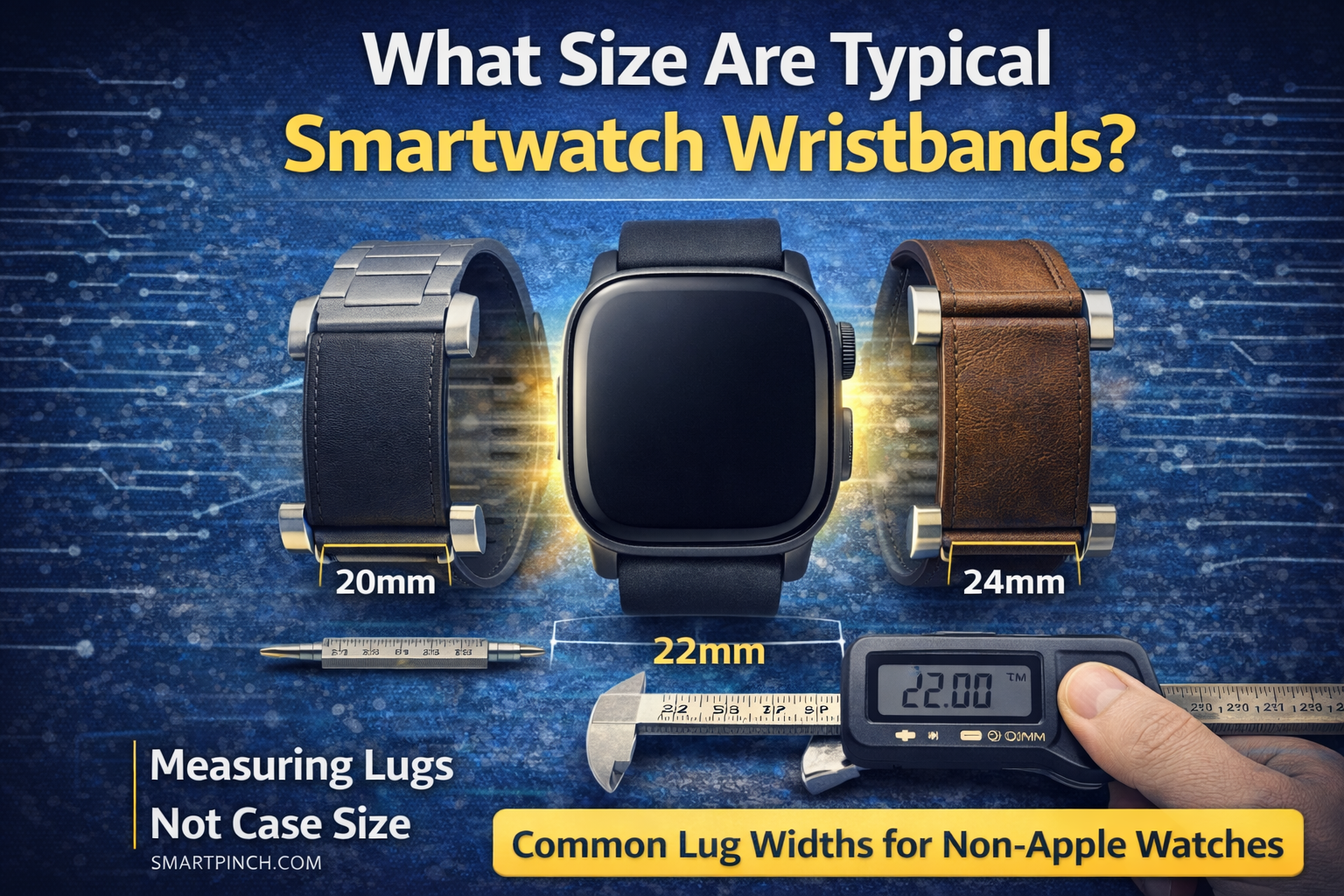
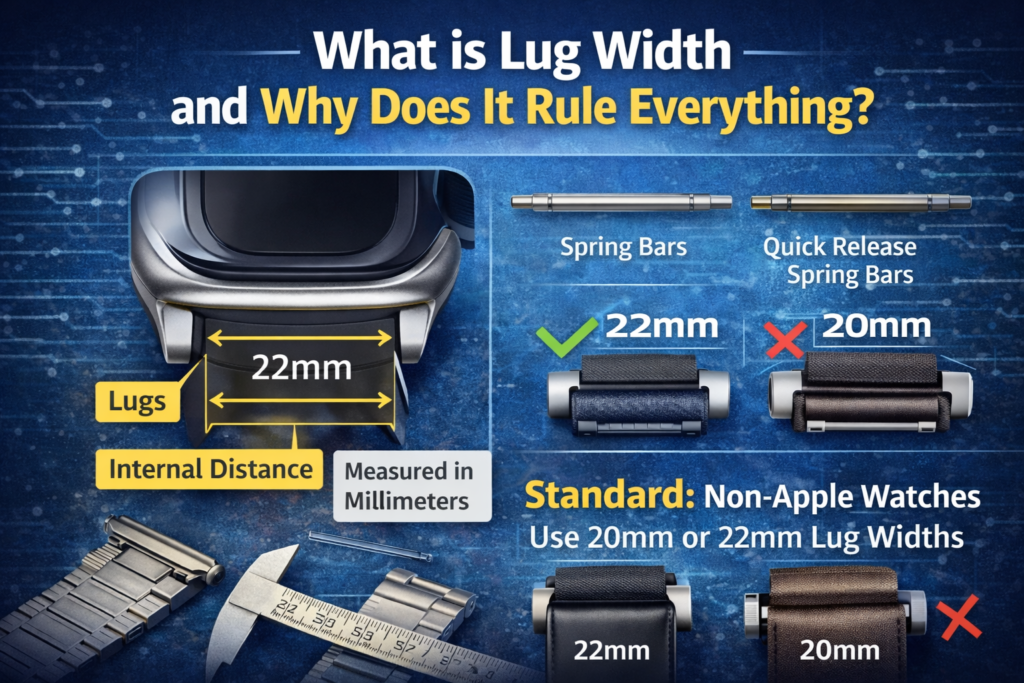
Before we look at specific brands, you must understand the language of watchmaking. The most critical measurement for any watch strap is the Lug Width.
The Lugs are the two metal horns that protrude from the top and bottom of your watch case. They hold the strap in place.
- The Measurement: Lug width is the internal distance between these two horns, measured in millimeters (mm).
- The Standard: The vast majority of non-Apple smartwatches use either 20mm or 22mm lug widths.
- The Trap: Many people confuse Case Size (a 44mm watch) with Lug Width (a 20mm strap). Never buy a strap based on your case size alone unless you are buying for an Apple Watch.
How Does the Spring Bar System Work?
The mechanism that holds your strap to the lugs is called a Spring Bar.
- Standard Spring Bar: A metal tube with retractable tips. You need a specialized fork tool to remove these.
- Quick Release (The Modern Standard): This is what you want. It looks like a standard bar but has a tiny metal lever protruding from the underside. You can slide this knob with your fingernail to detach the strap in seconds without any tools.
What Are the Risks of the Wrong Size?
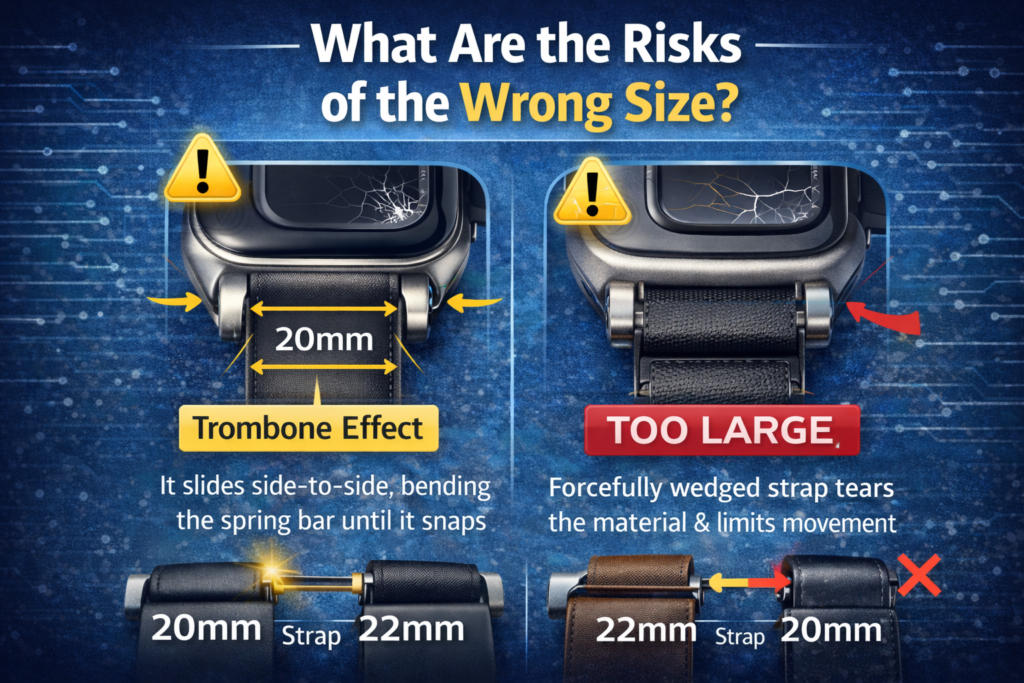
- Too Small (20mm strap on 22mm lugs): The strap will slide side-to-side (the “trombone effect”). This movement can bend the spring bar until it snaps, causing the watch to fall.
- Too Large (22mm strap on 20mm lugs): You might be able to force it in, but the friction will prevent the strap from rotating freely. It will feel stiff and eventually tear the material of the strap.
The Apple Watch Ecosystem
How Does Apple’s Proprietary System Work?
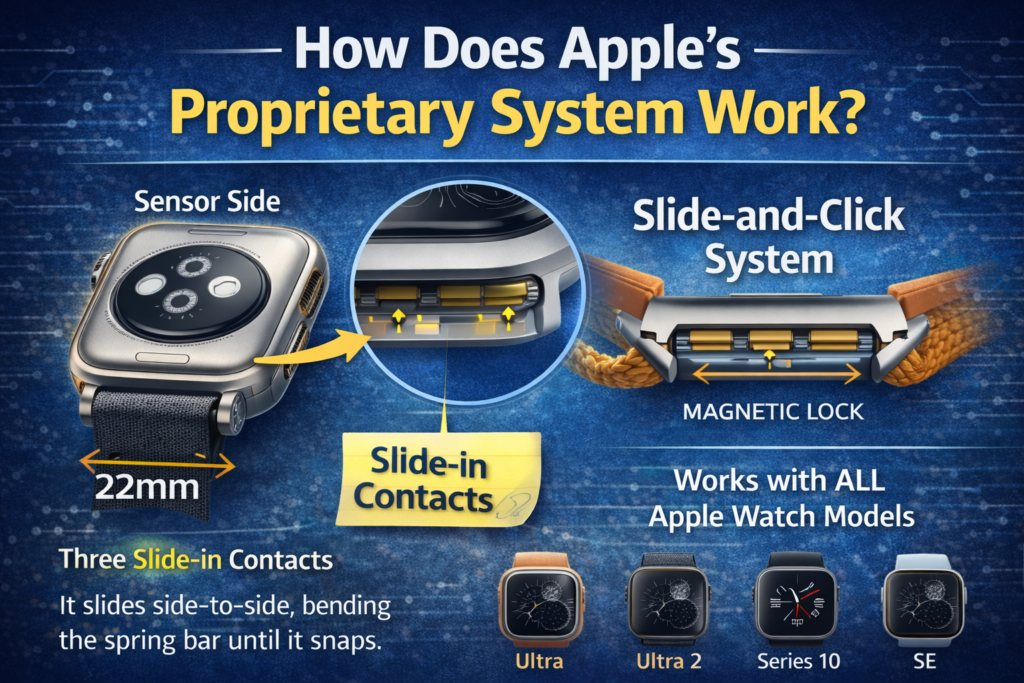
Apple ignores the millimeter lug standard entirely. Instead, they use a proprietary Slide-and-Click connector. Three small contacts slide into a channel on the watch case and lock magnetically.
Despite releasing a new watch every year for a decade, Apple has maintained incredible backward compatibility. However, the naming convention changed in late 2024 with the Series 10, creating mass confusion.
Which Apple Watch Size Do You Actually Have?
To find your size, look at the back of your watch (the sensor side). The text engraved around the sensors will list a millimeter size ( 41mm).
The Small Group (Interchangeable) If you have any of the following watches, they all use the same connector size. You can swap bands between them freely.
- 38mm: Series 1, 2, 3
- 40mm: Series 4, 5, 6, SE (Gen 1 & 2)
- 41mm: Series 7, 8, 9
- 42mm: Series 10 (New Standard)
Wait, didn’t 42mm used to be large? Yes. This is the main point of confusion. The old Series 3 “42mm” was a Large watch. The new Series 10 “42mm” is a Small watch with a bigger screen.
The “Large” Group (Interchangeable) These watches share the wider connector.
- 42mm: Series 1, 2, 3 (The old “Large”)
- 44mm: Series 4, 5, 6, SE
- 45mm: Series 7, 8, 9
- 46mm: Series 10 (New Standard)
- 49mm: Ultra & Ultra 2
Can You Mix and Match Sizes?
- Small Band on Large Watch: Yes, it will lock in place but there will be a visible gap on the sides of the connector. It looks cosmetic, but it is secure.
- Large Band on Small Watch: No. The connector will overhang the case edges. This creates a sharp edge that can snag on clothing or scratch your skin.
The Samsung Galaxy & Android Standard
Why Is 20mm the Magic Number for Samsung?
Samsung has done a tremendous service to the consumer by standardizing almost their entire wearable lineup. If you own a Galaxy Watch released in the last 4 years, it almost certainly uses a 20mm Quick Release band.
This standardization means you have access to thousands of third-party straps-leather, nylon, metal, ceramic-without paying Samsung tax.
What Are the Exceptions to the 20mm Rule?
While 20mm is dominant, older or Pro models differ.
The 20mm Universal List:
- Galaxy Watch 7 (40mm & 44mm)
- Galaxy Watch 6 (40mm & 44mm)
- Galaxy Watch 6 Classic (43mm & 47mm)
- Galaxy Watch 5 / 5 Pro
- Galaxy Watch 4 / 4 Classic
- Galaxy Watch 3 (41mm version only)
- Galaxy Watch Active 1 & 2
The 22mm Legacy List:
- Galaxy Watch 3 (45mm version)
- Original Galaxy Watch (46mm)
- Gear S3 Frontier / Classic
What About the Galaxy Watch Ultra?
The Galaxy Watch Ultra (released alongside the Watch 7) uses a new, proprietary lug system similar to Apple’s Ultra, designed for extreme durability.
- The Connector: A specialized Dynamic Lug system.
- The Solution: You cannot use standard 20mm bands directly. However, Samsung sells Lug Adapters that click into the Ultra and provide a standard 22mm bar, allowing you to use traditional straps again.
The Google Pixel Watch Complexity
How Does the Pixel Camera Lens Mechanism Work?
Google uses a unique twist-lock mechanism inspired by camera lenses. You press a button, slide the band and twist it to lock. It is elegant but it means you cannot use standard watch bands without an adapter.
What Changed with Pixel Watch 3?
For the Pixel Watch 1 and 2, there was only one size (41mm). With the Pixel Watch 3, Google introduced a larger 45mm size, and this broke compatibility.
The “Small” Pixel Band (41mm)
- Compatible with: Pixel Watch 1, Pixel Watch 2, Pixel Watch 3 (41mm).
- Note: These bands are physically too narrow for the 45mm watch.
The Large Pixel Band (45mm)
- Compatible with: Pixel Watch 3 (45mm) ONLY.
- Warning: If you are upgrading from a PW2 to a PW3 XL, your old collection of bands becomes useless.
Where Can I Find Adapters?
If you want to use a standard leather strap on a Pixel Watch, search for Pixel Watch Lug Adapter.
- For the 41mm watch, get a 20mm adapter.
- For the 45mm watch, get a 22mm adapter.
- Pro Tip: Buy metal adapters that match your watch case color (Matte Black, Polished Silver or Champagne Gold) for a seamless look.
The Garmin Ecosystem
What is the Difference Between QuickFit and QuickRelease?
Garmin users have the hardest time because Garmin uses two different systems depending on how expensive the watch is.
- Quick Release: Used on entry-to-mid-range watches (Venu, Vivoactive, Forerunner 265). This is the standard industry pin system.
- QuickFit: Used on high-end adventure watches (Fenix, Epix, Enduro, Marq). This is a proprietary snap-on system where the band clips onto a solid metal bar. It is designed to be impossible to detach accidentally during extreme sports.
Which Size Does Your Garmin Need?
Garmin sizes are strictly dictated by the case size letter (S, Regular, X).
18mm Quick Release:
- Venu 2S / 3S
- Vivoactive 4S
- Forerunner 255S / 265S
20mm Quick Release:
- Venu 2 / Plus / 3
- Vivoactive 5
- Forerunner 55 / 165 / 245 / 645
- Approach S42
22mm Quick Release:
- Vivoactive 4 (Legacy)
- Venu 3 (Large)
- Forerunner 255 / 265 (Large)
20mm QuickFit (Small Fenix):
- Fenix 6S / 7S / 8S (42mm case)
- Epix Pro (42mm)
22mm QuickFit (Standard Fenix):
- Fenix 6 / 7 / 8 (47mm case)
- Epix Gen 2 / Pro (47mm)
- Forerunner 965 (Uses 22mm bar but fits QuickFit straps)
26mm QuickFit (The Behemoths):
- Fenix 6X / 7X / 8X (51mm case)
- Enduro 1 / 2 / 3
- Tactix 7 / Delta
How to Measure Your Lug Width
How Do I Measure Without Calipers?
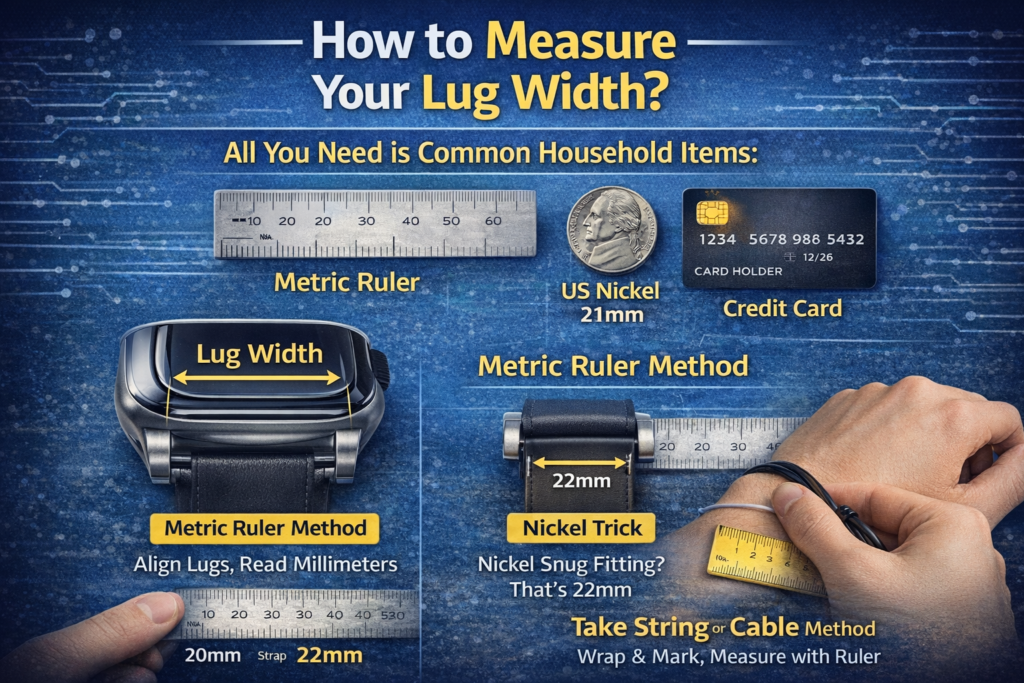
If you have a watch from a brand not listed here (like Wyze, Mobvoi TicWatch or a generic Amazon brand) you need to measure it yourself. You do not need professional tools; you just need common household items.
The Metric Ruler Method:
- Lay a ruler flat on a table.
- Place your watch on top of the ruler.
- Align the inside of the left lug with the “0” mm mark.
- Look at the inside of the right lug.
- It will almost always be an even number (18, 20, 22). If it looks like 19.8mm, it is 20mm.
The Credit Card & Coin Trick:
- US Nickel: A nickel is exactly 21.2mm wide.
- If the nickel fits between the lugs with a large gap, you have a 24mm or 26mm lug.
- If the nickel almost fits but is slightly too big, you have a 20mm lug.
- If the nickel fits snugly with a tiny wiggle, you have a 22mm lug.
How Do I Determine Strap Length for My Wrist?
Lug width attaches the strap to the watch; strap length attaches the watch to you. Wrist circumference is usually measured in inches or millimeters.
Common Wrist Sizes:
- 6.0 – 6.5 inches (150-164mm): Small. You need a “Short” band (usually labeled 120/70mm).
- 6.6 – 7.0 inches (165-178mm): Average. Standard bands fit perfectly.
- 7.1 – 8.0 inches (179-203mm): Large. Standard bands fit, but might be on the last hole.
- 8.1+ inches (205mm+): Extra Large. You must seek out “XL” or “Long” straps.
How to Measure Your Wrist: If you don’t have a flexible tape measure, take a piece of string or a charging cable. Wrap it around your wrist bone comfortably. Mark the point where it overlaps with a pen. Lay the string flat against a ruler.
Material Science – Which Strap is Right for You?
What is Fluoroelastomer and Why is it Better than Silicone?
You will often see Apple and Samsung describe their sport bands as “Fluoroelastomer,” while cheaper bands are “Silicone.”
- Silicone: Cheap, soft and slightly sticky. It attracts lint and dust like a magnet. Over time, it can become shiny or sticky as the oils break down.
- Fluoroelastomer: A synthetic rubber designed for high resistance to heat, oils and chemicals. It feels denser, smoother, and does not attract dust. It is hypoallergenic and lasts years longer than basic silicone.
- Verdict: If you have sensitive skin, pay the extra $10 for Fluoroelastomer.
When Should You Use Nylon (Velcro)?
Nylon “Sport Loops” are the unsung heroes of the smartwatch world.
- Pros: They offer “infinite adjustability.” Unlike a buckle with holes every 5mm, Velcro lets you get the exact tightness you need for heart rate accuracy. They breathe, reducing “wrist rot” (that funky smell under a rubber watch band).
- Cons: They absorb water. If you shower with a Nylon band, you will have a wet cuff for 30 minutes.
Why Is Titanium Worth the Premium?
For metal bands, you usually have a choice between Stainless Steel (316L) and Titanium (Grade 2 or Grade 5).
- Weight: Steel is heavy. A full steel bracelet can add 100g to your wrist, which causes the watch to bounce during a run, ruining heart rate data. Titanium is 40% lighter.
- Temperature: Steel feels freezing cold in winter and hot in summer. Titanium has low thermal conductivity, so it always feels neutral against the skin.
Maintenance & Hygiene
How Often Should You Clean Your Watch Band?
You wear your watch more than your favorite pair of jeans, yet most people rarely clean it.
- Silicone/Rubber: Wash with warm soapy water every time you shower. Accumulation of sweat and dead skin cells is the #1 cause of “Watch Rash.”
- Nylon: Throw it in the washing machine inside a pocket (zippered) or a delicates bag once a week. Air dry only.
- Leather: Wipe with a damp cloth only. Use a leather conditioner once every 6 months to prevent cracking.
When Should You Replace a Spring Bar?
If you hear a “clicking” sound when you move your wrist, or if the band feels loose at the connection point, replace the spring bars immediately. Spring bars are mechanical parts with internal springs that rust and weaken over time. A set of 20mm spring bars costs $5; a new Galaxy Watch costs $300.
The Perfect Fit is Waiting
Finding the right smartwatch band isn’t just about fashion; it’s about protecting your investment and ensuring your health data is accurate. A loose band ruins heart rate tracking. A tight band causes skin irritation. A cheap pin causes a broken screen.
By understanding the simple numbers-20mm, 22mm or the specific generation of your Apple/Pixel Watch-you can unlock a world of customization.
Don’t settle for the sweaty, uncomfortable plastic strap that came in the box. Measure your lugs, check the chart above and upgrade your wrist game today.