
If you are choosing between a Google Home speaker vs Alexa in 2026, the short answer is this: the Amazon Echo Dot Max sounds better for most music, and the Google Home Speaker understands you better. Both cost $99.99 at list price, both are the first speakers in their lines built around an AI assistant rather than a command parser, and both hide their best features behind a subscription. The right one for you depends on whether you listen more than you talk to it — and on which company’s services already run your home.
The Short Answer: Google Home Speaker vs Alexa
- Buy the Echo Dot Max if you mainly play music, you want the most bass for $100, you have Amazon Prime, or your smart home runs on Zigbee devices.
- Buy the Google Home Speaker if you ask your speaker questions all day, you live in YouTube Music, Gmail and Google Calendar, or you want the fastest, most natural voice responses.
- Buy neither yet if you already own a Nest Audio or an Echo (4th Gen) that still works — both are discontinued but still supported, and neither new speaker is a big enough sound upgrade to justify replacing a working one.
Meet the 2026 Speakers
Both companies replaced their entire $100 speaker line-up in the last year, which is why so many comparison articles you find online are already wrong. Here is what is actually on sale now.
| Google Home Speaker (2026) | Amazon Echo Dot Max (2025) | |
|---|---|---|
| Price | $99.99 | $99.99 (on sale $49.99, late Nov 2026) |
| Launched | June 25, 2026 | October 29, 2025 |
| Replaces | Nest Audio and Nest Mini (both discontinued) | Echo (4th Gen) (discontinued) |
| Driver | Single 58mm driver | 2.5-inch woofer + 0.8-inch tweeter |
| Assistant | Gemini for Home (on-device NPU) | Alexa+ (AZ3 chip) |
| Smart home radios | Matter, Thread border router | Zigbee, Matter, Thread border router |
| Extras | Wi-Fi 6 | eero built-in, Omnisense presence and temperature sensing, Wi-Fi 6E |
| Subscription catch | Google Home Premium, $10/month, for the best Gemini features | Alexa+ free with Prime, $19.99/month without Prime |
| Size and weight | 3.4 in tall, 4.2 in diameter, 0.9 lb | 4.27 x 4.27 x 3.9 in, 1.11 lb |
The naming is confusing on purpose, so be careful when you shop. “Google Home Speaker” is the name of the 2026 hardware — not the Google Home app, and not the old 2016 Google Home. And Amazon has never made a fifth-generation standard Echo: the Dot Max is the step above the new Echo Dot (2026), which replaced the Echo Dot (5th Gen) in October 2026 at $49.99.
Which Smart Speaker Sounds Better?
This is the question the title asks, so here is the honest answer: for music, the Echo Dot Max wins on paper and in early listening reports. For spoken word, it is a tie.
Bass and loudness: Echo Dot Max
The Dot Max is the first Dot with a real two-way speaker system — a dedicated tweeter for the highs and a high-excursion woofer for the lows. Amazon claims nearly three times the bass of the old Echo Dot, and the 2.5-inch woofer moves noticeably more air than the Google Home Speaker’s single 58mm driver. It also has automatic room adaptation, which tunes the sound to the room it sits in. If you play pop, hip-hop or electronic music at anything above background volume, the Dot Max sounds bigger, fuller and more fun.
Vocals and clarity: Google Home Speaker
Google tuned its speaker for clarity rather than thump. Spoken voices, acoustic guitar and podcasts come through clean, and the single-driver design keeps the midrange — where human voices live — from getting muddy. It is the same tuning philosophy that made the old Nest Audio the reviewers’ pick for vocal clarity over the bass-heavy Echo (4th Gen). The catch is that the new speaker’s 58mm driver is smaller than the Nest Audio’s 75mm woofer, so it does not play as loud or as deep as its own predecessor.
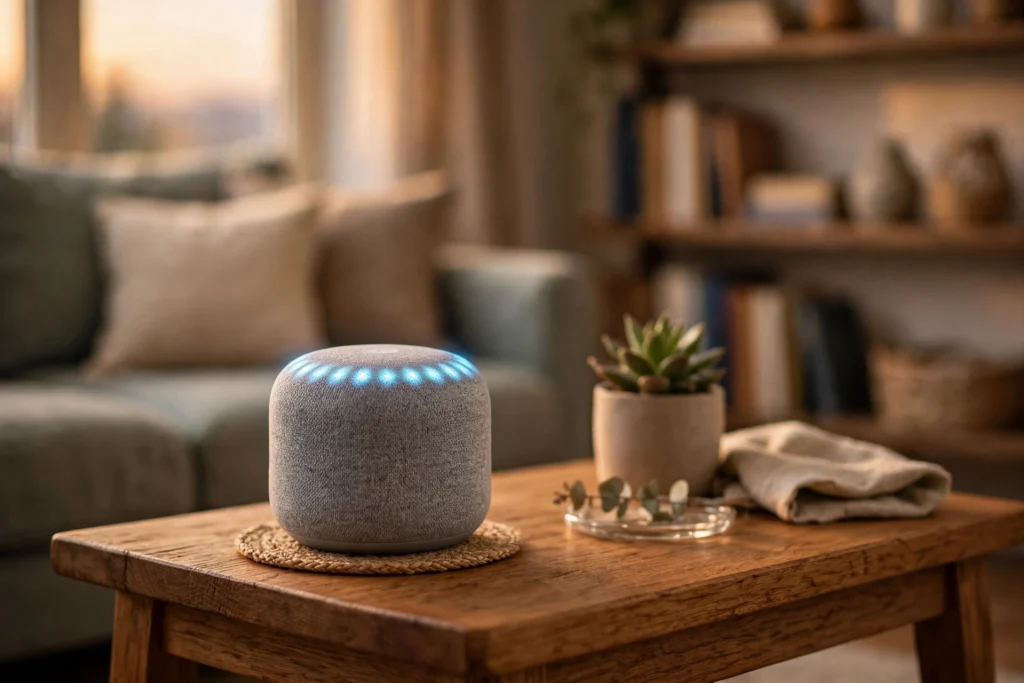
How they compare by what you listen to
| What you listen to | Google Home Speaker | Echo Dot Max |
|---|---|---|
| Pop and hip-hop | Clean but thin at high volume | Better — deeper bass, more energy |
| Acoustic and classical | Better — clearer mids and vocals | Good, but bass can crowd the mids |
| Podcasts and audiobooks | Excellent — voice-first tuning | Excellent — equally clear |
| News and radio | Excellent | Excellent |
| Background music while cooking | Fine | Better — fills the room more easily |
| A party or a big living room | Struggles — single small driver | Better, but still a $100 speaker |
One more honest note: both of these are single mono speakers. Neither one will replace a real stereo, and neither one sounds as good as the Sonos Era 100, which costs about twice as much. If sound quality is your only priority and your budget stretches, buy the Sonos. If your budget is $100, the Dot Max gives you more speaker for the money — especially while it is on sale for $49.99.
Stereo pairing
Both speakers can be paired with a second identical unit for true stereo separation, and both sound much better that way. A pair of Dot Max speakers costs $199.98 at list (or about $100 on sale), and a pair of Google Home Speakers costs $199.98. If you are setting up a living room, two cheaper speakers in stereo will beat one expensive speaker almost every time.
Gemini for Home vs Alexa+: The Assistant Question
Sound is only half the purchase. In 2026 both speakers are really AI assistants with a speaker attached, and the assistant you prefer may matter more than the driver size.
Gemini for Home (Google)
Gemini for Home replaces Google Assistant entirely. Because it is built on a large language model, it understands natural speech without rigid command templates — you can ask follow-up questions without repeating yourself, and it holds short-term conversational memory. The Google Home Speaker runs Gemini Nano on a dedicated neural processing unit inside the speaker, so standard commands answer in under 100 milliseconds, according to Google, and basic voice processing works without an internet connection. The base experience — smart home control, music, questions, timers, calendar — is free. The catch: the most interesting Gemini features need Google Home Premium Standard at $10 a month. The launch offer of six free months ended on September 30, 2026.
Alexa+ (Amazon)
Alexa+ is Amazon’s generative-AI upgrade to Alexa, built for back-and-forth conversation and multi-step requests — “turn off the lights, lock the door and set the alarm for 7” in one breath. It runs on the Dot Max’s AZ3 chip and is included in Early Access with the speaker. The catch is the price after Early Access: Alexa+ is free if you pay for Amazon Prime, and $19.99 a month if you do not. That makes the Dot Max a much better deal for Prime households than for anyone else.
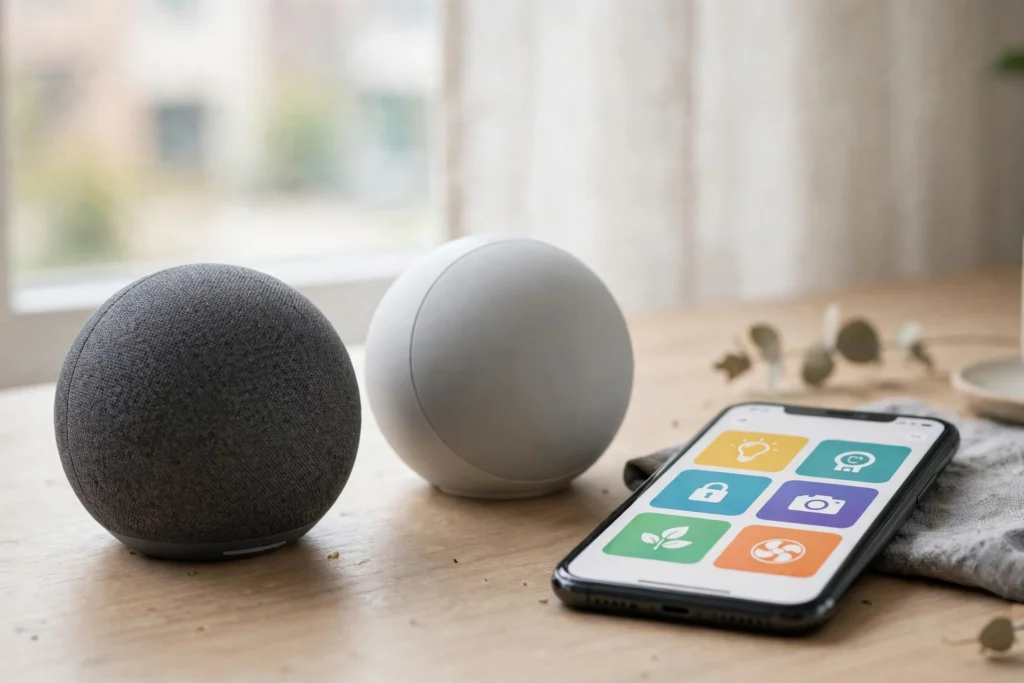
| Gemini for Home | Alexa+ | |
|---|---|---|
| Free tier | Base assistant free | Early Access included with the speaker |
| Full experience | Google Home Premium, $10/month | Free with Prime, $19.99/month without Prime |
| Natural conversation | Yes — follow-ups without repeating context | Yes — up to 8 turns of context |
| On-device processing | Yes — Gemini Nano on the NPU | Partial — AZ3 chip, mostly cloud |
| Works offline | Basic commands, yes | No |
If you already pay for Prime, the Dot Max’s assistant is effectively free. If you already pay for Google services and YouTube Premium, the Google Home Speaker fits your home better. If you pay for neither, add $10–$20 a month to the true cost of whichever speaker you pick — or accept the free tier, which is still a big step up from the old assistants on both sides.
Smart Home Control: Who Talks to More Devices?
If you are building a smart home, the speaker is also the hub, and here the Echo Dot Max has the clear edge. It has Zigbee, Matter and a Thread border router built in, so it can control Zigbee bulbs, sensors and plugs directly with no extra hub. The Google Home Speaker has Matter and a Thread border router, but no Zigbee radio — Zigbee devices need their own bridge. Both work with the big platforms, and Matter means the gap matters less every year, but if you already own Zigbee gear, the Dot Max saves you a hub.
That said, do not buy a speaker as your only hub without reading our guide to “Do You Need a Smart Home Hub in 2026?” first — a dedicated hub such as the ones in our “Best Smart Hubs in 2026” roundup is still the better choice for a large or complicated home. And if you are choosing between the two whole ecosystems rather than just the speakers, our “Alexa vs Google Home vs Apple HomeKit” comparison covers that decision in full.
Microphones, Privacy and Always Listening
Both speakers listen for a wake word all the time — that is how a voice assistant works — and both let you switch the microphones off with a physical button. The Google Home Speaker has the edge on paper: because Gemini Nano runs on-device, basic commands are processed inside the speaker instead of being sent to Google’s servers. Alexa+ still does most of its thinking in the cloud. In practice, both companies record and store voice interactions by default, and both let you review and delete them in their apps. If always-listening worries you, use the mic-off button when you leave the room, and set up auto-delete for voice recordings in the Google Home or Alexa app.
Which One Should You Buy?
| Your situation | Buy this |
|---|---|
| You listen to a lot of music | Echo Dot Max — bigger sound, and $49.99 on sale |
| You ask questions all day | Google Home Speaker — Gemini understands follow-ups better |
| You have Amazon Prime | Echo Dot Max — Alexa+ is included |
| You live in Google services (YouTube Music, Gmail, Calendar) | Google Home Speaker |
| You own Zigbee bulbs or sensors | Echo Dot Max — built-in Zigbee hub |
| You want the best sound per dollar right now | Echo Dot Max at the $49.99 sale price |
| You want a bedroom or kitchen speaker | Either — both are overkill for a small room; consider the Echo Dot (2026) at $49.99 instead |
| You already own a Nest Audio or Echo (4th Gen) | Neither — keep what you have until it dies |
If you are starting a smart home from scratch, read “How to Start a Smart Home” before you buy anything — the speaker is the easy part, and the plan matters more than the hardware.
What About the Old Models?
You will still see the Nest Audio and the Echo (4th Gen) in “best of” lists and on sale at third-party retailers. Both are discontinued — Google ended the Nest Audio and Nest Mini in June 2026, and Amazon replaced the Echo (4th Gen) with the Dot Max. Existing units keep working, keep getting software updates, and older Nest speakers will get Gemini for Home over time. Buying one used is fine if the price is low (under $50), but do not pay full price for a discontinued speaker when its replacement costs the same $99.99.
How to Get the Best Sound From Either Speaker
- Put it at ear height, not on the floor. A speaker on a low shelf or the floor loses its highs to the furniture.
- Keep it away from walls and corners. A few inches of space behind the speaker tightens the bass; pushed into a corner, the Dot Max in particular gets boomy.
- Turn on room adaptation on the Dot Max. It is in the Alexa app under Device Settings, and it retunes the speaker to your room.
- Use the EQ. Both apps have a simple bass/treble equaliser. If the Dot Max sounds muddy on podcasts, drop the bass two notches; if the Google Home Speaker sounds thin on music, raise the bass one notch.
- Pair two for stereo. A second identical speaker, placed 6–10 feet apart, is the single biggest sound upgrade either system offers.
Frequently Asked Questions
Which smart speaker sounds better, Google Home Speaker or Alexa?
For music, the Echo Dot Max sounds better — its two-way speaker with a dedicated tweeter and 2.5-inch woofer has deeper bass and more volume than the Google Home Speaker’s single 58mm driver. For podcasts and spoken word, they are about equal, and the Google Home Speaker is slightly clearer on vocals.
Is the Google Home Speaker the same as the Nest Audio?
No. The Google Home Speaker launched in June 2026 and replaces the Nest Audio, which Google discontinued at the same time. It is smaller, runs Gemini for Home on a dedicated NPU, and adds a Thread border router — but its 58mm driver is smaller than the Nest Audio’s 75mm woofer.
Is the Echo Dot Max the same as the Echo (4th Gen)?
No. The Echo Dot Max launched in October 2025 and effectively replaces the Echo (4th Gen) at the same $99.99 price. It adds a dedicated tweeter, the AZ3 chip, a built-in Zigbee/Matter/Thread hub, and Alexa+.
Do I need a subscription for Gemini for Home or Alexa+?
The base assistant is free on both. The best Gemini features need Google Home Premium at $10 a month. Alexa+ is free with Amazon Prime and $19.99 a month without Prime once Early Access ends.
Can I use a Google Home Speaker with Alexa devices, or vice versa?
Mostly, no — each speaker runs its own assistant and its own app. But Matter-compatible devices can work with both ecosystems, so a Matter bulb or plug can be controlled from either speaker. Check the Matter logo before you buy.
Should I buy one speaker or two?
If the speaker is mainly for music in a living room, buy two identical speakers and pair them in stereo — the improvement is bigger than any single-speaker upgrade. If it is for a bedroom, kitchen or office, one is enough.
The Bottom Line
The Google Home speaker vs Alexa question in 2026 is really two questions. If you want the better-sounding speaker, buy the Echo Dot Max — especially while it is $49.99. If you want the smarter assistant, buy the Google Home Speaker and its on-device Gemini. Either way, check which subscriptions you already pay for before you decide, because Prime and Google Home Premium change the real price of both speakers by $10–$20 a month.
Prices and subscription terms change often — the prices in this post were checked on November 27, 2026, and sale prices in particular may have ended by the time you read this. Check the current price before you buy.