
How Long Does an eMTB Battery Last? The Short Answer
How long does an eMTB battery last? On a single charge, a typical full-power eMTB with a 600–800 Wh battery covers roughly 25–80 miles (40–130 km) of trail riding, depending on assist mode, rider weight, terrain, and elevation — and over its whole life, the same battery lasts around 500–1,000 full charge cycles, or roughly 3–6 years for most riders, before its capacity drops noticeably. There is no single number, because “how long” means three different things: range per charge, hours of riding, and total lifespan in years. This guide answers all three, with real 2026 figures for Bosch, Shimano, and DJI systems, charging times, and what a replacement actually costs.
The short version: a bigger battery (measured in watt-hours, or Wh) goes further per charge, but it also weighs more. A 400 Wh battery is light and nimble but runs out fast on steep trails. An 800 Wh battery is the 2026 full-power standard and will get most riders through a full day on the trails. And whichever battery you have, how you ride it and how you charge it matters as much as its size.
What “Battery Life” Actually Means: Three Different Answers
When riders ask how long an eMTB battery lasts, they usually mean one of three things — and the answer is different for each.
Range per charge is how far you can ride before the battery is empty. This is the number that matters on a ride, and it is the one that varies most, because it depends on assist mode, climbing, rider weight, tyres, and temperature.
Riding time per charge is how many hours the battery lasts. On steep, technical trails in Boost or Turbo mode, a full-power eMTB can drain a battery in 2–3 hours. On gentle fire roads in Eco mode, the same battery can last 4–6 hours or more. Shimano frames it by elevation rather than distance: on its STEPS system, a battery lasts roughly 2,000 feet of climbing in Boost mode, about 3,000 feet in Trail mode, and 4,000 feet or more in Eco mode.
Total lifespan is how many years the battery keeps working before it needs replacing. Lithium-ion batteries do not suddenly die — they slowly lose capacity with every charge. Most manufacturers rate their packs for 500–1,000 full charge cycles before capacity drops to around 60% of new. For a weekend rider who charges once or twice a week, that is roughly 5–7 years. For a daily rider, it is closer to 3–5 years. Even at 60% capacity, the battery still works — you just get noticeably less range per charge.
How Far Can You Ride on One Charge? Battery Size vs Range
Battery capacity is measured in watt-hours (Wh). More Wh means more stored energy, and more energy means more range — but the relationship is not exact, because a heavier bike and a more powerful motor use energy faster.
The table below gives realistic trail ranges, not manufacturer maximums. Manufacturer figures are usually measured in Eco mode on flat ground with a light rider, so treat them as best-case numbers. The ranges here are for mixed trail riding with a typical adult rider.
| Battery size | Typical bikes | Realistic trail range | Best for |
|---|---|---|---|
| 250–400 Wh | Lightweight eMTBs (e.g. Specialized SL, Orbea Rise SL) | 15–40 miles (25–65 km) | Short rides, light handling, riders who pedal hard |
| 500–625 Wh | Mid-power and older full-power bikes | 20–50 miles (30–80 km) | Half-day rides, moderate climbing |
| 600–750 Wh | Most 2026 full-power eMTBs | 25–60 miles (40–100 km) | The sweet spot for most riders |
| 800–900 Wh | Flagship full-power bikes (Bosch, DJI Avinox) | 35–80+ miles (55–130 km) | Full-day rides, big climbing days |
| 800 Wh + 250 Wh extender | Bosch PowerTube 800 + PowerMore 250 | Up to 100+ miles (160+ km) | All-day epics, bikepacking |
A concrete example: Bosch’s PowerTube 800 is rated for up to around 100 miles in ideal conditions, and Canyon’s 800 Wh eMTBs are rated for up to 85 km (about 53 miles) or 1,900 m of climbing per charge, depending on terrain and riding style. DJI rates the 800 Wh Avinox battery on the Amflow PL Carbon Pro for up to 157 km (about 98 miles) — but that is under controlled test conditions in Eco mode on flat ground, and real trail riding will be far less. The honest rule: take the manufacturer’s maximum, then expect roughly half of it on a real mountain-bike ride with serious climbing.
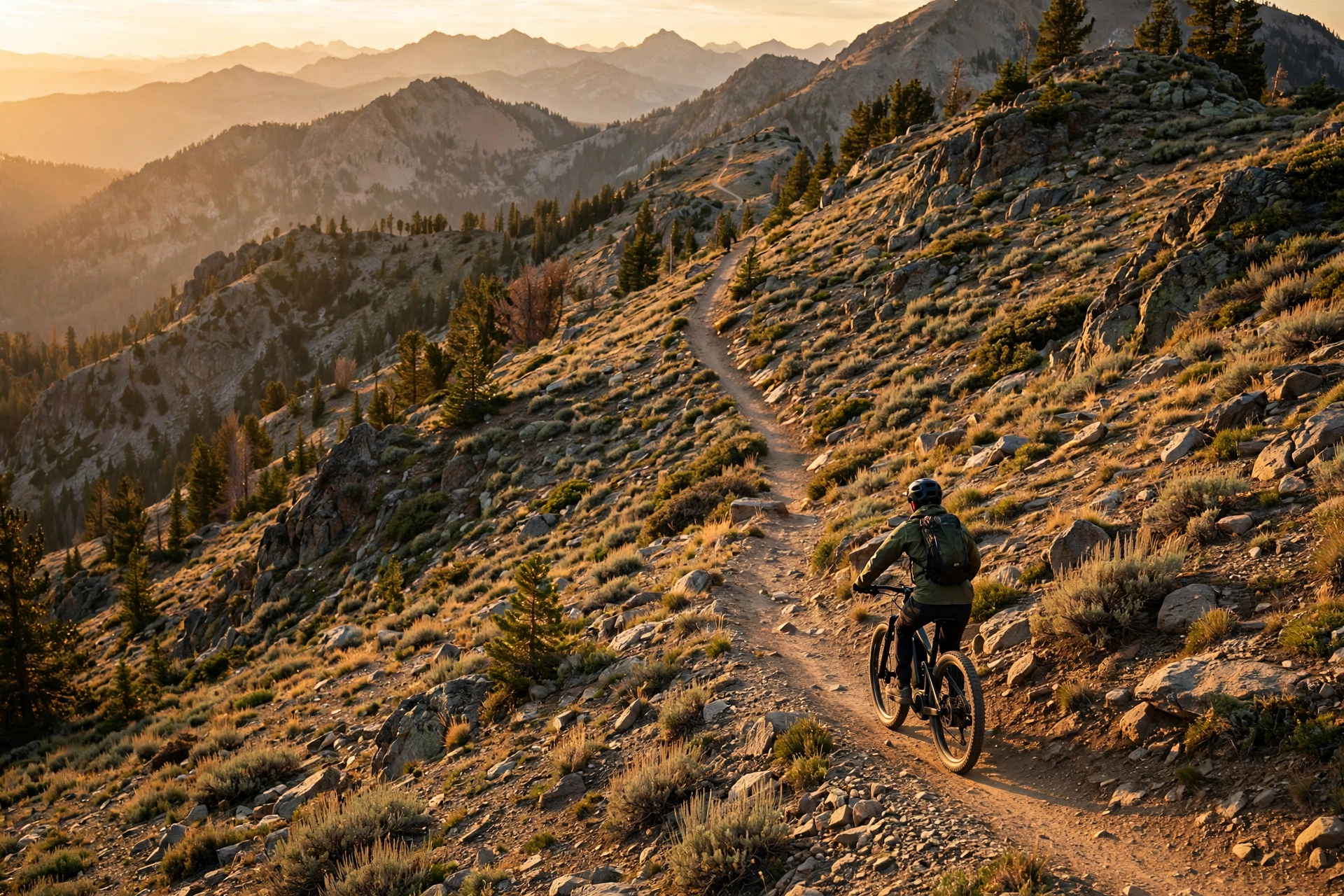
What Drains an eMTB Battery Fastest?
If two riders have the same battery and one gets twice the range, the difference is almost always one of these six factors.
Assist mode. This is the biggest factor by far. Turbo or Boost mode can use two to three times as much energy as Eco mode. Riding a whole climb in Turbo will drain a battery in a fraction of the time Eco would take. The smartest riders save Turbo for the steepest pitches and ride Eco or Trail everywhere else.
Climbing. Elevation gain eats battery faster than distance. A 20-mile ride with 1,000 m of climbing uses far more energy than a 40-mile flat ride. Think in vertical metres, not miles, when planning a ride — Shimano’s elevation rule above is a good mental model.
Rider and bike weight. A heavier rider, a heavier bike, and a loaded pack all demand more power, especially uphill. A 100 kg rider will get noticeably less range than a 70 kg rider on the same bike and mode.
Tyres and terrain. Soft, muddy ground and grippy, high-rolling-resistance tyres cost range. So does stop-start technical riding with constant acceleration. Smooth fire roads are the most efficient terrain there is.
Temperature. Lithium-ion batteries lose capacity in the cold, just like a phone in winter. Below about 10°C (50°F), expect a noticeable range drop. Store and charge the battery at room temperature, and keep it warm (indoors, not in a cold garage) before a winter ride.
Motor system. Full-power motors (85–120 Nm of torque) use more energy than lightweight systems (50–60 Nm), because they do more of the work for you. That is the trade-off: more power, less range per Wh. Our guide to buying an eMTB explains how torque, motor power, and battery size fit together when you are choosing a bike.
Battery Size in 2026: What the Main Systems Offer
The 2026 eMTB market has settled around a few clear battery sizes, and knowing them helps you compare bikes honestly.
| System | Main batteries | Range extender | Charging (full, standard charger) |
|---|---|---|---|
| Bosch Smart System (Performance Line CX Gen 5) | PowerTube 600 Wh (3.0 kg), PowerTube 800 Wh (3.9 kg); CompactTube 400 Wh (2.0 kg) | PowerMore 250 Wh (1.6 kg) — 800 + 250 = 1,050 Wh total | About 4.2 h (600 Wh), about 5.7 h (800 Wh) with a 2A charger; faster with a 4A/6A charger |
| Shimano EP801 / EP8 | BT-E8035 504 Wh, BT-E8036 504 Wh, BT-E8038 630 Wh; some bikes up to 900 Wh with third-party packs | 252 Wh range extender on some models | About 4–5 h full charge; about 80% in 2.5 h |
| DJI Avinox | 600 Wh or 800 Wh (about 3.74 kg for the 800 Wh pack) | No extender on most models yet | 0–75% in about 90 minutes with the GaN fast charger |
| Specialized (Turbo Levo) | 700 Wh (M2/M3) on full-power Levo; 320 Wh on SL lightweight models | 160 Wh range extender (SL) | Around 4–5 h full charge |
| TQ / Yamaha / Brose | 360–720 Wh depending on model | Varies by brand | Around 3–5 h full charge |
Two things stand out in 2026. First, 800 Wh is now the full-power standard — it is common on new Bosch and DJI bikes, and it is the size to look for if you want all-day range. Second, range extenders have gone mainstream: Bosch’s PowerMore 250 adds 250 Wh in a bottle-cage-sized pack, taking a PowerTube 800 bike to 1,050 Wh in total, and Bosch draws power evenly from both packs, which also helps battery health. Shimano’s system drains the main battery first before tapping the extender.
One caution: batteries are not interchangeable between brands. Bosch uses a closed system — only Bosch batteries fit Bosch bikes. Shimano allows bike makers to use third-party packs, but the battery must still be approved for your exact bike. Never buy a cheap unbranded battery for a branded system: it can be a fire risk, it will void your warranty, and it may not fit or communicate with the motor at all.
How Long Does It Take to Charge an eMTB Battery?
Charging time depends on battery size and charger speed. As a rough guide:
- 400–500 Wh batteries: roughly 2–3 hours for a full charge.
- 600–750 Wh batteries: roughly 3–5 hours.
- 800–900 Wh batteries: roughly 4–6 hours.
Bosch’s own figures with its standard 2A charger are about 2.8 hours for the CompactTube 400, 4.2 hours for the PowerTube 600, 4.6 hours for the PowerTube 625, 5.3 hours for the PowerTube 750, and 5.7 hours for the PowerTube 800. A faster 4A or 6A charger cuts those times significantly — Canyon’s 800 Wh bikes reach 80% in about 2 hours with the faster charger and a full charge in about 5 hours. DJI’s GaN fast charger is the quickest of the current systems, taking the Avinox 800 Wh battery from 0 to 75% in around 90 minutes, which makes a mid-ride cafe top-up a realistic range strategy.
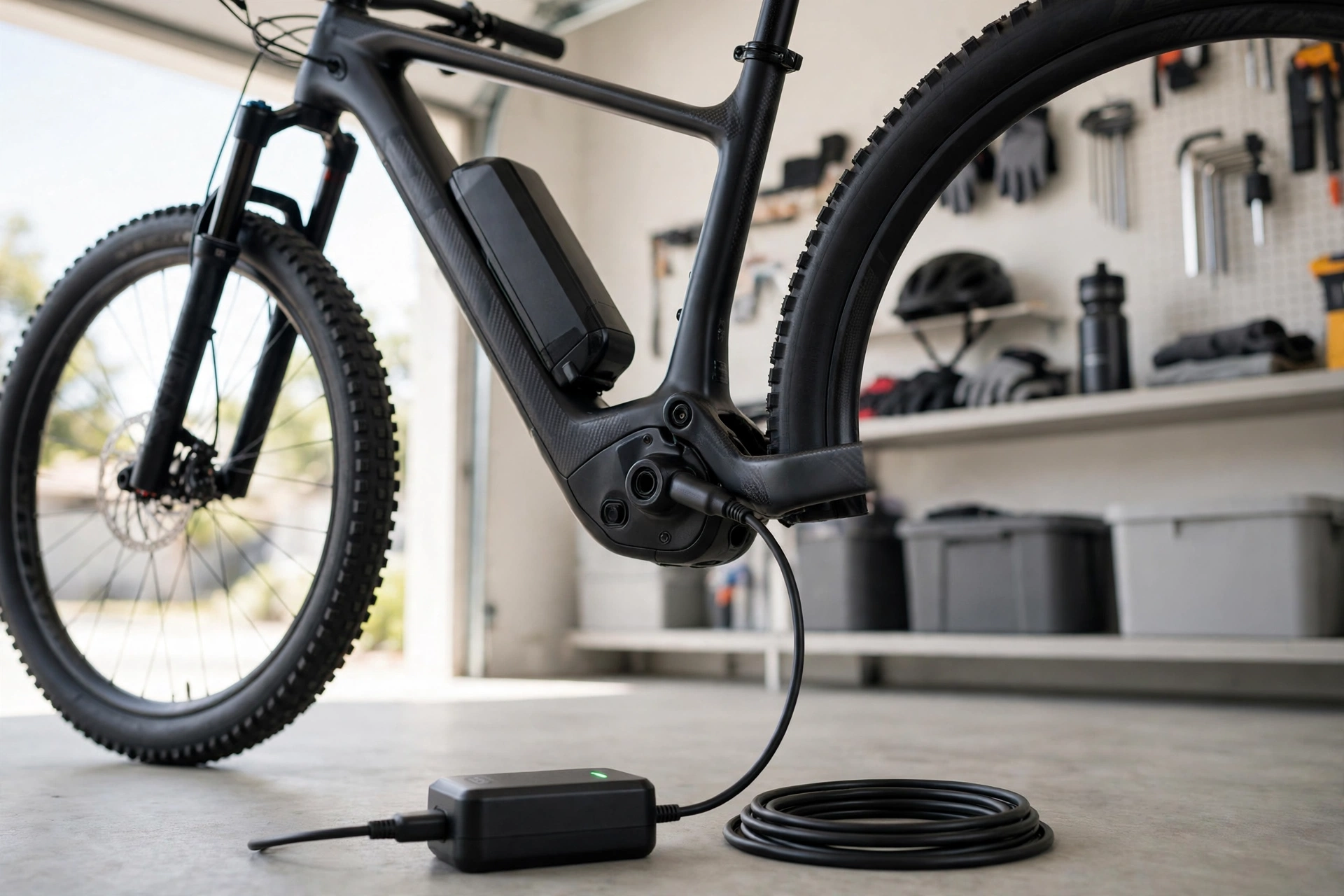
Practical tips: you can charge the battery on the bike or remove it and charge it indoors — removing it is easier and safer in cold weather, and it means you do not need a power socket next to where the bike is stored. Most batteries reach about 80% fairly quickly and then slow down for the last 20%, which is normal: the battery management system (BMS) slows charging near full to protect the cells. Do not leave a battery on the charger for days at a time, and do not store a fully charged battery for months — for long-term storage, leave it at around 30–60% charge in a cool, dry place.
How Long Does an eMTB Battery Last Before It Needs Replacing?
This is the lifespan question, and the honest answer is measured in charge cycles, not just years.
Bosch rates its batteries for a lifespan of roughly 800–1,000 charging cycles, and guarantees they will hold at least 60% of their original capacity after 500 cycles or two years of use, whichever comes first. Shimano guarantees its STEPS batteries (for example the BT-E8036) will hold at least 60% of maximum charge after 1,000 charges, and its E-TUBE app shows you the battery’s state of health and charge-cycle count directly. Giant claims its Panasonic-cell batteries are good for up to 2,300 full charges. These numbers differ because each brand measures and guarantees differently — the practical takeaway is the same: expect 500–1,000 full cycles, or about 3–6 years of regular riding, before range drops enough to matter.
A “full cycle” means a full 100% of charge used, not one plug-in. Charging from 50% to 100% twice counts as one full cycle, so topping up after short rides does not burn through cycles the way people fear. What does wear a battery out is heat, deep discharges, and sitting at 100% or 0% for long periods. Turbo-only riding on steep hills also shortens life: heavy, sustained loads generate heat, and heat is the enemy of lithium-ion cells.
Signs your battery is wearing out: range drops by 30–40% from when it was new on the same routes and modes; the battery percentage falls quickly at the start of a ride; the bike cuts assist early even though the display shows charge remaining; or the battery swells, gets unusually hot while charging, or smells strange. Swelling or heat is a safety issue — stop using it and take it to a dealer immediately.
How Much Does an eMTB Battery Replacement Cost?
Replacement cost is where sources disagree most, so here are the ranges honestly, with the caveat that prices vary by country, retailer, and exact part number — always check the price for your specific battery before ordering.
| Replacement type | Typical cost | Notes |
|---|---|---|
| Generic / budget e-bike battery (300–400 Wh) | Around $350–$450 | Aftermarket packs; not for branded eMTB systems |
| Branded mid-capacity (500–600 Wh, Bosch/Shimano) | Around $550–$800 | OEM packs from dealers; US retailer listings vary widely |
| Branded high-capacity (750–800 Wh, Bosch/Shimano) | Around $750–$1,200+ | Larger packs cost more; some US listings run higher |
| Premium OEM (e.g. Specialized 700 Wh) | Up to around $1,700 | One US retailer listing (Oct 2026) for a bare 700 Wh pack |
| Range extender (e.g. Bosch PowerMore 250) | Around $400–$600 | Cheaper than a full battery; adds 250 Wh |
In Europe, branded replacements commonly run €400–€900 depending on capacity, and several 2026 guides put the typical branded range at €600–€900. In the US, a set of 16 dated retailer listings checked in October 2026 ran from $349.99 for a small generic pack to $1,699.99 for a Specialized 700 Wh pack, with Bosch and Shimano OEM packs in the $750–$1,150 range. The wide spread is real: a battery is not a commodity, and the price depends on the exact part, the retailer, and whether a charger or fitting is included.
Three cost rules: buy only the exact part number for your bike — a battery that looks the same may have a different connector or firmware; budget for fitting if the dealer installs it (usually a small labour charge, but some integrated batteries take longer); and check your warranty first — a battery that has lost capacity unusually fast may be covered, and Bosch, for example, has replaced packs that dropped below 70% within 500 cycles under some programmes.
If the replacement cost is close to the value of the bike, that is the point where many riders decide to sell the bike and buy new instead — especially on older bikes where the motor and drivetrain are also wearing out. A battery is the most expensive single component on an eMTB, and it is worth factoring into the total cost of ownership before you buy. Our eMTB buying guide covers total ownership costs alongside motor and battery choice.
How to Make Your eMTB Battery Last Longer
You cannot stop a lithium-ion battery ageing, but you can slow it down a lot. These are the habits that make the biggest difference:
- Ride Eco and Trail more, Turbo less. Turbo is fun, but it draws the most current and generates the most heat. Use it for short, steep pitches, not whole climbs.
- Keep the battery between 20% and 80% when you can. You do not need to be strict about this — just avoid regularly running it to empty or leaving it at 100% for days. Many systems (Bosch Smart System, Shimano) let you set a charge limit in the app; use it for everyday riding and charge to 100% only before a big ride.
- Charge at room temperature. Never charge a freezing-cold battery straight after a winter ride — let it warm up indoors first. Likewise, do not charge in direct sun or a hot car.
- Store it partly charged. For storage of weeks or months, leave the battery at 30–60% in a cool, dry place, and top it up every few months. Never store it flat (0%) or full (100%).
- Keep it clean and dry. Wipe the battery and its contacts after wet or muddy rides, and check the seals. Water in the battery compartment is a common cause of faults.
- Update the firmware. Motor and battery firmware updates (through the Bosch eBike Flow, Shimano E-TUBE, or DJI apps) often include battery-management improvements. Keep yours current.
- Use the right charger. Only use the charger supplied with your bike or an official replacement. Fast chargers are fine when the manufacturer offers them, but a random high-amp charger can damage the pack.
- Remove the battery for transport and storage. It is lighter to carry, safer in a crash, and easier to keep at the right temperature — and on some bikes it is also a theft deterrent.
When to Replace (and When Not To)
Do not replace a battery just because it is a few years old. Replace it when the range no longer covers the rides you actually do — if your regular loop used to take 40% and now takes 70%, the battery has lost about a third of its capacity, and that is the practical threshold for most riders. If you only ride short loops, a degraded battery may serve you for years longer.
Before buying a replacement, rule out the cheap causes of short range: a dragging brake, under-inflated tyres, a dry chain, cold weather, and riding in Turbo all cut range without the battery being at fault. Check the battery’s state of health in your bike’s app (Bosch Flow, Shimano E-TUBE) — if it shows above 70–80%, the battery is probably fine and something else is eating your range.
Also check trail access before planning a longer ride on a bigger battery: a bigger battery does not change where you are allowed to ride. Our guide on whether a Class 3 eMTB is allowed on trails explains how trail access works by class and land manager, which matters more than range when you are choosing where to ride.
The Bottom Line
How long does an eMTB battery last? Per charge, expect roughly 25–80 miles of trail riding from a 600–800 Wh battery, with Eco mode and gentle terrain at the top end and Turbo mode and steep climbing at the bottom. Over its life, expect 500–1,000 full charge cycles — about 3–6 years for most riders — before capacity drops to around 60% and a replacement starts to make sense. Charging takes 3–6 hours on a standard charger, less with a fast charger. And a replacement will typically cost $550–$1,200+ for a branded Bosch or Shimano pack, so it is worth looking after the battery you have: ride Eco more, keep it between 20% and 80%, charge it at room temperature, and store it partly charged. Do that, and your battery will last as long as the bike around it.
FAQs: How Long Does an eMTB Battery Last?
How long does an eMTB battery last on one charge?
It depends on battery size and assist mode. A 600–800 Wh battery typically gives 25–80 miles (40–130 km) of trail riding per charge. Eco mode and flat terrain give the most range; Turbo mode and steep climbing give the least. Expect roughly half the manufacturer’s maximum figure on a real mountain-bike ride.
How many years does an eMTB battery last?
Most lithium-ion eMTB batteries last 500–1,000 full charge cycles, which works out to roughly 3–6 years for regular riders and 5–7 years for weekend riders. The battery does not die suddenly — it gradually loses capacity, and it is usually worth replacing once range has dropped by 30–40% from new.
How long does it take to charge an eMTB battery?
About 2–3 hours for a 400–500 Wh battery, 3–5 hours for 600–750 Wh, and 4–6 hours for 800–900 Wh on a standard charger. Fast chargers cut this significantly: Bosch’s faster chargers reach 80% in about 2 hours on an 800 Wh pack, and DJI’s GaN charger takes an Avinox battery from 0 to 75% in around 90 minutes.
Can I make my eMTB battery last longer?
Yes. Ride in Eco or Trail mode more and Turbo less, keep the charge between 20% and 80% for everyday use, charge at room temperature, store the battery partly charged (30–60%) if you are not riding for weeks, and keep the firmware updated. Avoid running the battery to empty regularly and avoid heat.
How much does it cost to replace an eMTB battery?
It varies widely by brand and capacity. Generic packs run around $350–$450, branded Bosch or Shimano packs typically run $550–$1,200+, and some premium OEM packs have been listed up to around $1,700 in the US. In Europe, branded replacements commonly run €400–€900. Always check the price for your exact part number, and buy only a battery approved for your bike.
Is it worth replacing an eMTB battery, or should I buy a new bike?
Replace the battery if the rest of the bike is in good condition — a new battery is much cheaper than a new bike. If the motor, drivetrain, and suspension are also worn out, or the replacement cost is close to the bike’s resale value, selling and buying new usually makes more sense. Check your warranty first: unusually fast capacity loss may be covered.