
The Best eBike Trails in the US: The Short Answer
The best e bike trails in the US in 2026 split into two kinds of riding, and the right pick depends on your bike and your legs. For real mountain biking, the standouts are Moab’s newly opened Class 1 singletrack in Utah, Bentonville’s purpose-built flow trails in Arkansas, and lift-served Mammoth Mountain Bike Park in California. For long, easy, scenic days, the Katy Trail in Missouri (240 miles), the Great Allegheny Passage (150 miles), and the Mickelson Trail in South Dakota (109 miles) are hard to beat. The one rule that decides whether any of them is open to you: most trails allow Class 1 pedal-assist e-bikes only, Class 2 throttles are welcome on rail trails but rarely on singletrack, and Class 3 bikes are banned on almost every trail in this list. Check the class rule for your trail before you load the bike — it changed in 2026, and the old lists are out of date.
The 10 Best eBike Trails at a Glance
| Trail | State | Miles | Type | E-bike class allowed | Best season |
|---|---|---|---|---|---|
| Moab singletrack (Navajo Rocks, Klondike Bluffs) | Utah | 200+ | Desert singletrack | Class 1 only | Spring, fall |
| Bentonville (Slaughter Pen, Coler) | Arkansas | 150+ | Flow singletrack | Class 1 | Spring, fall |
| Mammoth Mountain Bike Park | California | 80+ | Lift-served bike park | Class 1 | Summer |
| Kingdom Trails | Vermont | 100+ | Flowy singletrack | Class 1 | Summer, fall |
| Post Canyon | Oregon | 40+ | Flow, jumps, XC | Class 1 | Spring–fall |
| Hartman Rocks | Colorado | 40+ | Rocky desert singletrack | Class 1 on designated trails | Late spring–fall |
| Katy Trail | Missouri | 240 | Rail trail | Class 1 and 2 | Spring, fall |
| Great Allegheny Passage | Pennsylvania–Maryland | 150 | Rail trail | E-bikes under 750 W / 100 lbs | Spring, fall |
| Mickelson Trail | South Dakota | 109 | Rail trail | Class 1 only | Summer, fall |
| Monterey Bay Coastal Trail | California | 18 one-way | Paved coastal path | Class 1 and 2 | Year-round |
What Changed in 2026: Moab Opened to Class 1 eBikes
If you read a “best e-bike trails” list from 2024 or earlier, treat its Moab section as history. On March 1, 2026, the Bureau of Land Management’s Moab Field Office opened nearly 200 miles of mountain bike singletrack to Class 1 e-bikes — trails that had been closed to any motor, including e-bike motors, for years. The decision followed a public comment period in 2025 and applies to signed trails only: Navajo Rocks, Klondike Bluffs, Klonzo, Moab Brands, Horsethief, Amasa Back, and others on the BLM’s interactive map.
Two catches matter. First, only Class 1 is allowed — pedal assist up to 20 mph, no throttle. Class 2 and Class 3 bikes stay off Moab singletrack entirely. If you are unsure which class your bike is, read our guide to Class 1 vs Class 2 vs Class 3 eBikes before you go. Second, the full Whole Enchilada is still closed to e-bikes. The route’s singletrack sections — Lower Porcupine Singletrack and Porcupine Rim Singletrack — remain off-limits, so the famous descent cannot be ridden end-to-end on an eMTB. Ride the open systems instead, and treat trailhead signage as the final word: the BLM list changes, and a sign beats any article, including this one.
The Moab change is part of a wider pattern. Land managers are opening trails to Class 1 e-bikes one system at a time, while keeping throttles and 28 mph bikes out. That is why a trail list without a class column is useless in 2026 — and why every trail below names the class it allows.
The Best eMTB Singletrack Trails
These six are the rides to plan a trip around. All of them allow Class 1 eMTBs; none of them welcome a throttle or a Class 3 bike on singletrack.
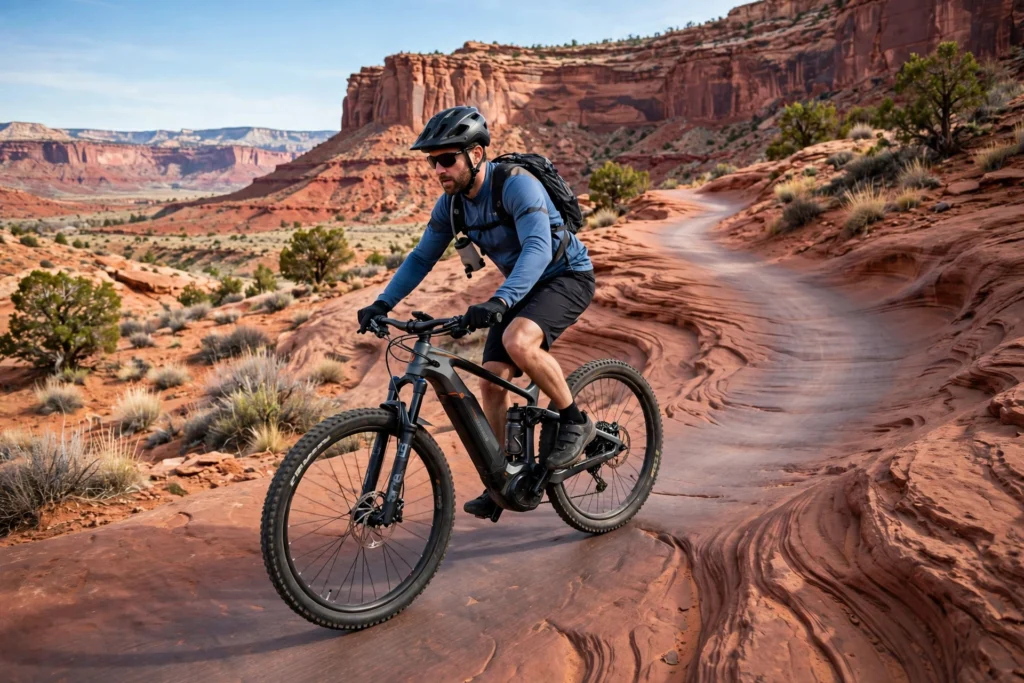
1. Moab, Utah — Navajo Rocks and Klondike Bluffs
The headline ride of 2026. Navajo Rocks is a rolling 17-mile loop system of smooth slickrock and dirt with big desert views and almost no technical climbing — exactly the kind of trail an eMTB flattens into a fun half-day. Klondike Bluffs, just north of town, adds flowy singletrack and the famous Dino-Flow section. Both are Class 1 only, signed at the trailhead, and best ridden in spring or fall: Moab summer regularly tops 100°F, and there is no shade and no water on the trail. Bring more water than you think you need, and start early.
2. Bentonville, Arkansas — Slaughter Pen and Coler
Bentonville calls itself the Mountain Biking Capital of the World, and for eMTB riders it earns the title. The town has more than 150 miles of trails, much of it built specifically for bikes, and Class 1 e-bikes are welcome on the city trail systems. Slaughter Pen is the downtown network — flow trails, jump lines, and cross-country loops you can ride straight from a coffee shop. Coler Mountain Bike Preserve, a few minutes away, adds a hub with a skills area, a pump track, and the gravity-fed Fire Line descent. The riding is green, rolling, and forgiving, which makes Bentonville the best first eMTB destination on this list. Spring and fall are ideal; summer is humid but rideable in the morning.
3. Mammoth Mountain Bike Park, California
The only lift-served bike park on this list, and the easiest way to rack up downhill laps on an eMTB. Mammoth has more than 80 miles of trails, from smooth beginner flow to steep technical descents, and Class 1 eMTBs are allowed in the park. The gondola does the climbing, so your battery goes entirely to the fun part — but that also means you will burn through laps fast, so plan a midday charge or bring a second battery if you ride hard. Summer is the season; the park typically runs from late June to September, and the high altitude (over 8,000 feet at the summit) makes the air thin and the views enormous.
4. Kingdom Trails, Vermont
More than 100 miles of smooth, flowy singletrack winding through forests and farmland in Vermont’s Northeast Kingdom. Kingdom Trails is famous for trails that feel built by riders, for riders — berms, rollers, and gentle climbs that suit an eMTB perfectly. Class 1 e-bikes are allowed on most of the network, but some trails cross private land, so check the trailhead signs and the Kingdom Trails map before you ride. Summer and fall are the seasons; fall foliage here is genuinely worth timing a trip around. Note that Kingdom Trails is a paid network — buy a day pass or membership before you ride.
5. Post Canyon, Oregon — Hood River
Post Canyon is Hood River’s backyard trail system: flowy downhill descents, jump lines, and cross-country singletrack in a working county forest, about an hour east of Portland. Class 1 e-bikes are allowed, and the trail mix suits every level — mellow cross-country loops at the bottom, steep jump trails at the top. It is a good second stop on an Oregon trip after the rail trails, and the town of Hood River has bike shops, rentals, and food within minutes of the trailhead. Ride spring through fall; winter brings rain and muddy closures.
6. Hartman Rocks, Gunnison, Colorado
Hartman Rocks is high-desert BLM riding at its best: rocky, technical singletrack with big views of the Gunnison valley, and free camping right at the trailhead. E-bikes are allowed on designated trails here — stick to the signed routes, because the system mixes motorized and non-motorized trails and the rules differ by segment. The altitude (around 7,700 feet) and the rocky terrain make this the most demanding ride on this list, and the best choice if you want a quieter alternative to the big-name destinations. Late spring through fall is the window; the trails hold snow into May.
The Best Long Scenic eBike Rail Trails
Not every great e-bike day needs singletrack. Rail trails — old railway lines converted to flat, car-free paths — are where an e-bike’s range really shines, and the rules are friendlier: most of them welcome Class 1 and Class 2 bikes.
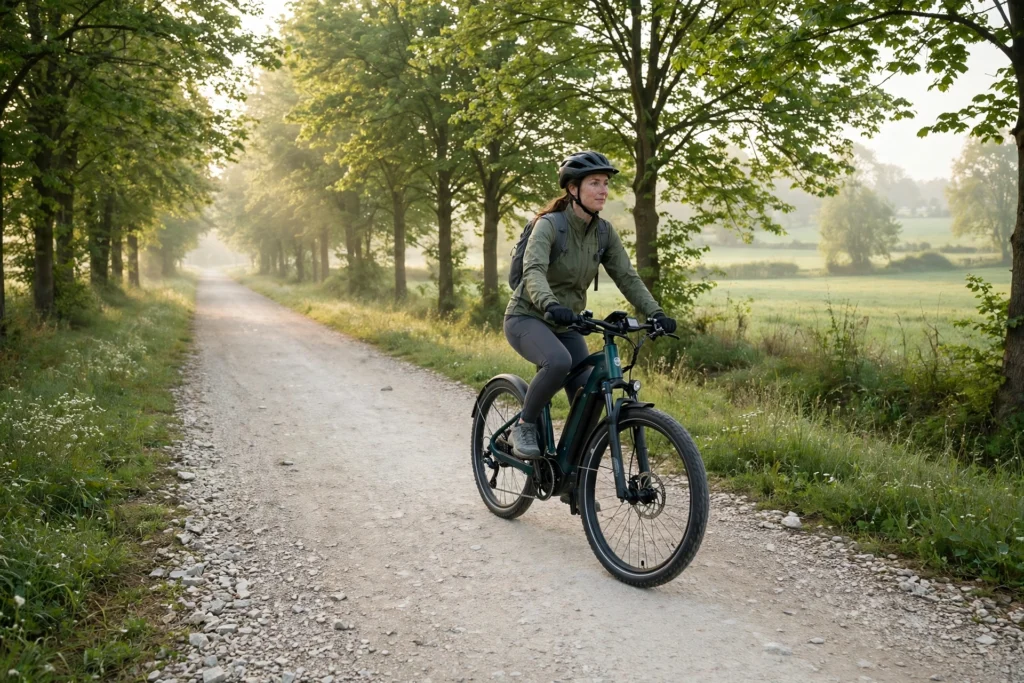
7. Katy Trail, Missouri — 240 Miles
The longest rail trail in the US, running 240 miles across Missouri along the Missouri River. The surface is crushed limestone, the grades are gentle, and the trail passes through small towns with food, water, and places to stay — which is what makes a multi-day e-bike trip realistic. Class 1 and Class 2 e-bikes are allowed. Plan your charging: towns are spaced out, so know where the next outlet is before you leave the last one. Spring and fall are the best seasons; summer is hot and humid, winter is cold and quiet.
8. Great Allegheny Passage, Pennsylvania to Maryland — 150 Miles
The GAP runs 150 miles from Pittsburgh to Cumberland, Maryland, through river gorges, over viaducts, and past old railway towns. The rule is written in watts, not classes: e-bikes under 750 watts and 100 pounds are allowed, which covers most Class 1 and Class 2 bikes. The trail connects to the C&O Canal Towpath at Cumberland, so a strong rider can continue all the way to Washington, D.C. — 335 miles from Pittsburgh. Spring and fall are ideal; the trail is shaded, scenic, and well served by trail towns.
9. Mickelson Trail, South Dakota — 109 Miles
A 109-mile crushed-limestone trail through the Black Hills, from Deadwood to Edgemont, crossing more than 100 converted railway bridges and four rock tunnels. It is one of the prettiest rail trails in the country, and the rule is simple: Class 1 only, no throttle. The grades are gentle but the trail climbs steadily, so an e-bike turns a hard day into a comfortable one. Summer and fall are the seasons; the trail is at altitude, so mornings are cool even in July.
10. Monterey Bay Coastal Recreation Trail, California — 18 Miles
The shortest ride on this list, and the easiest to love. Eighteen paved miles along the Monterey Bay coast, from Castroville to Pacific Grove, past beaches, sea otters, and the Monterey Bay Aquarium. Class 1 and Class 2 e-bikes are allowed, the path is flat, and it is rideable year-round. It is the best pick on this list for a first e-bike ride, a family day, or anyone who wants scenery without a workout. Go early on weekends — the path is popular with walkers, runners, and other riders.
How to Pick a Trail for Your eBike Class
Your bike’s class decides your trail list more than your fitness does. Use this as a quick filter:
| Your bike | Singletrack and bike parks | Rail trails and paved paths |
|---|---|---|
| Class 1 (pedal assist, 20 mph) | Allowed on all 6 singletrack picks here, where signed | Allowed on all 4 rail trails here |
| Class 2 (throttle, 20 mph) | Almost never allowed on singletrack | Allowed on Katy, GAP, and Monterey Bay; not on the Mickelson |
| Class 3 (pedal assist, 28 mph) | Not allowed on singletrack | Not allowed on these trails — check local rules, and expect no |
Class 1 is the safest bike to own if trail riding matters to you: every trail on this list is open to it. Class 2 owners should plan around rail trails and paved paths. And Class 3 eMTBs are banned on almost every trail in the US — they are road and commuter bikes, not trail bikes, no matter what the motor can do. If you are shopping and trail access matters, that single fact should decide the class you buy.
Battery and Range: Planning a Long Trail Day
An eMTB changes the maths of a trail day: you can ride further, climb more, and finish fresher — but only until the battery runs out, and a dead eMTB is a very heavy regular bike. Before a long ride, know how long an eMTB battery lasts on your bike, in real conditions, not the number on the box. Three rules cover most trips:
- Budget 1,000 feet of climbing per 10% of battery as a rough rule of thumb on a full-suspension eMTB in trail mode. It varies with rider weight, assist level, and terrain, but it stops you planning a 3,000-foot climb on a half-charged battery.
- Eco mode is your friend on long trails. The Katy Trail and the GAP are flat enough that eco mode covers 60 to 80 miles on a 625 Wh battery. Save turbo for the climbs, not the flats.
- Know where the next charge is. Rail-trail towns have cafes and motels with outlets; Moab singletrack and Hartman Rocks do not. For remote rides, carry a second battery or plan a shorter loop — and never start a loop you cannot finish on the charge you have.
Before You Ride: A Quick Checklist
- Check the land manager, not the listicle. Trail rules change — Moab proved that in 2026. Check the BLM, Forest Service, state park, or trail association page for your trail before you travel.
- Confirm your class. Know whether your bike is Class 1, 2, or 3, and whether it has a throttle. A Class 2 bike with a disabled throttle is allowed on some Class 1-only trails (the Route of the Hiawatha does this at the trailhead), but only where the manager says so.
- Ride with a charged battery and a plan. Know the distance, the climbing, and the nearest charge point. If you are still buying an eMTB, range and battery size should be near the top of your list.
- Yield and announce. E-bikes are faster uphill than other riders expect. Slow down for hikers and horses, call out before passing, and remember that one bad interaction can close a trail to every e-bike.
- Pack for the place. Desert trails need water and sun protection; mountain trails need layers and a rain shell; rail trails need a charging plan. A flat repair kit and a multi-tool go on every ride.
Frequently Asked Questions
Where can I ride my eMTB in the US?
Class 1 eMTBs are welcome on a growing list of trails: Moab’s BLM singletrack (opened March 2026), Bentonville, Mammoth Mountain Bike Park, Kingdom Trails, Post Canyon, and Hartman Rocks for singletrack, plus rail trails like the Katy Trail, Great Allegheny Passage, Mickelson Trail, and Monterey Bay Coastal Trail. Always check the land manager’s current rules before you ride, because access changes.
Can I ride an e-bike on any mountain bike trail?
No. Most non-motorized singletrack in national forests is still closed to all e-bikes, and national parks generally allow e-bikes only on roads open to motor vehicles. Access depends on the land manager: the BLM has opened selected systems to Class 1 e-bikes, while the Forest Service has opened very few. A trail that allows regular mountain bikes does not automatically allow e-bikes.
Are Class 1 e-bikes allowed in Moab in 2026?
Yes — since March 1, 2026, the BLM Moab Field Office allows Class 1 e-bikes on nearly 200 miles of signed singletrack, including Navajo Rocks, Klondike Bluffs, Klonzo, and Moab Brands. Class 2 and Class 3 bikes are not allowed on that singletrack, and the full Whole Enchilada route remains closed to e-bikes because its Porcupine Rim singletrack sections are still off-limits.
What is the best e-bike trail for beginners?
The Monterey Bay Coastal Trail is the easiest start: 18 flat, paved miles along the California coast, open to Class 1 and Class 2 e-bikes, rideable year-round. For a first singletrack experience, Bentonville’s Slaughter Pen network is the best pick — flowy, forgiving trails you can ride straight from town, with rentals and bike shops nearby.
Do I need a special e-bike for rail trails?
No. Any Class 1 or Class 2 e-bike works on the rail trails in this list, and a hardtail or hybrid e-bike is often a better pick than a full-suspension eMTB on flat crushed limestone. What matters is range: a 240-mile trail like the Katy needs a charging plan, so a bigger battery or a second battery matters more than suspension.
Can I ride a Class 3 e-bike on trails?
Almost never. Class 3 e-bikes (pedal assist to 28 mph) are banned on nearly every singletrack and most rail trails in the US. They are built for roads and commuting. If trail riding is part of your plan, buy a Class 1 bike — it is the only class open on every trail in this guide.
The Bottom Line
The best e bike trails in the US in 2026 reward one thing above all: riding the right bike on the right trail. A Class 1 eMTB opens Moab’s new singletrack, Bentonville’s flow trails, and Mammoth’s lift-served descents — plus every rail trail on this list. A Class 2 bike still gets the Katy, the GAP, and Monterey Bay. A Class 3 bike gets the road. Pick your trail from the table, check the land manager’s current rules before you travel, charge the battery, and go ride — the trails are better than they have ever been for e-bikes, and the 2026 Moab opening is proof the map is still getting bigger.
Disclaimer: Trail access rules change — Moab’s 2026 opening is the latest example. Always confirm the current rules with the land manager (BLM, Forest Service, state park, or trail association) before you travel, and follow trailhead signage on the day. Distances, surfaces, and fees are as published in 2026 and may change. This article is general information for planning a ride, not a substitute for checking the official rules for your trail.